Decided in Silence
How absence becomes a decision, and who pays the cost.
For the citizen, parent, teacher, and leader. It opens on a camera installed in Troy, New York without a vote.
Read about Decided in Silence →Keeping your judgment and your accountability as AI moves into the work.
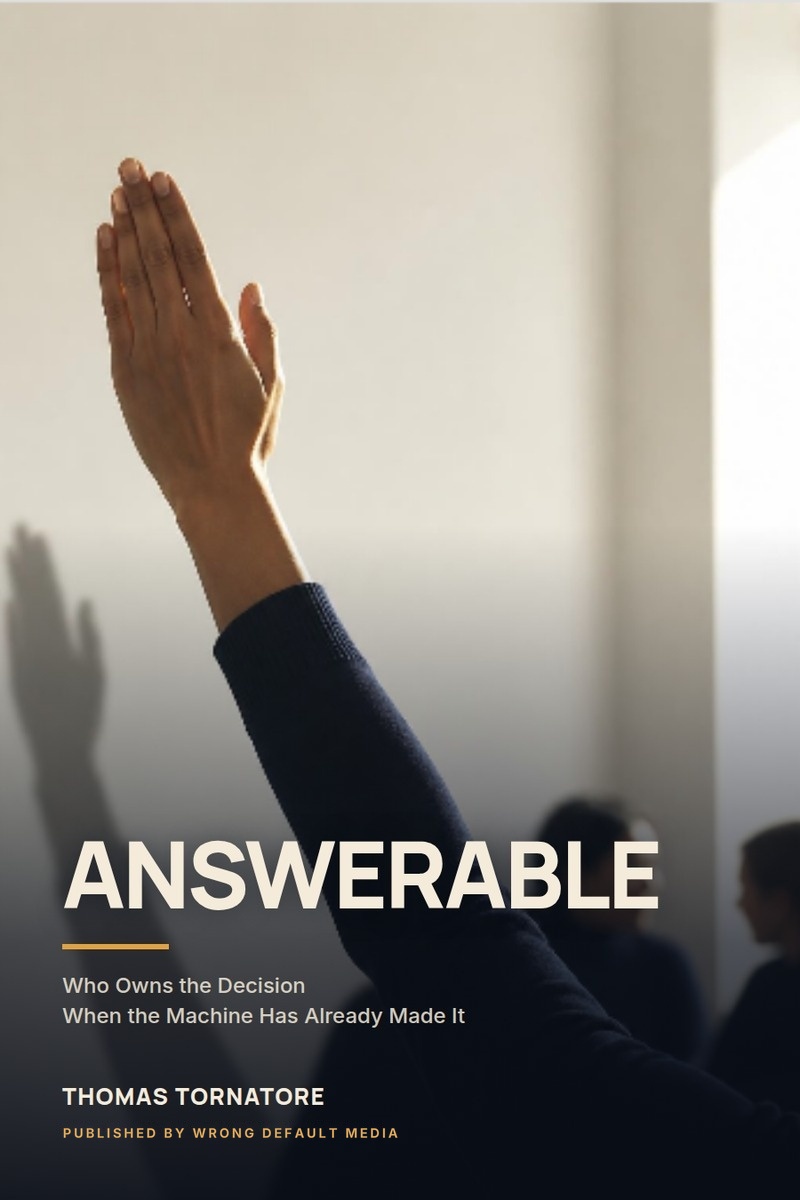
For the operator and the professional who can feel the crosshairs. Answerable is the companion to Decided in Silence, the same argument turned toward the person inside the work rather than the one setting the defaults.
As AI moves into the job, the easy path is to let the decision get made for you, quietly, by the tool and by the drift of everyone around you. This is a book about what it takes to keep your judgment, hold the context a working life builds, and stay in the decision instead of letting it be made by absence.
The call is yours to take. So is the accountability that comes with it. This is a book about keeping both, at the moment it would be easiest to hand them off.
Managers, executives, and the professionals who answer for a decision after a system helped make it: the people in general counsel, risk, security, and HR functions who are increasingly the ones asked to explain why an AI-assisted call went the way it did. If you can feel yourself getting closer to the edge of a decision no one has clearly claimed, it is written for you.
It is also for anyone who intends to stay in the decision rather than watch it get made for them: to keep the judgment a working life builds, instead of letting a tool and the drift of everyone around you make the call by default.
Decided in Silence is the public-facing half of this argument, written for the citizen, parent, teacher, and leader: the people who live inside these systems and were never asked. Answerable turns the same thesis toward the workplace, for the person expected to answer for what the system did. Where its companion opens on a camera installed without a vote, this one opens on a job lost to a finding no human ever reviewed, and closes on what it actually takes to own a decision instead of inheriting one.
The author is not a technologist selling optimism about the tools, or a critic selling alarm about them. He is a governance practitioner making one narrow claim: keep the human in the decision, and be able to say, afterward, why you made the call you made.
A woman in Michigan had just finished her training to become a police officer in Detroit. Then she failed the background check, and the job went away.
What the background check had flagged was a finding of fraud. Years earlier she had collected unemployment benefits, and a state computer system had decided, on its own, that she had lied to get them. She had never been told. The notice had gone to an online portal she had no reason to be checking, and when she did not respond within thirty days the decision became final and could not be appealed. By the time it surfaced on the background check it was simply true on the record: she was someone who had committed fraud. No person had ever looked at her case. No human had decided anything about her at all.
The system was called MiDAS. Michigan's Unemployment Insurance Agency installed it in 2013 to decide, automatically, whether a person had committed fraud in claiming benefits. That judgment could strip the benefits, quadruple the bill as a penalty, seize tax refunds, and garnish a quarter of a future paycheck, with no court and no hearing. In the same stretch, the agency laid off most of the workforce that had been reviewing applications and claims, nearly its entire fraud-detection unit. The humans who used to make the call were gone, and the call still had been made.
It was made wrong most of the time. Roughly forty thousand Michiganders were wrongfully accused, and later reporting and reviews placed the false-determination rate for the automated cases somewhere between eighty-five and ninety-three percent. At least eleven thousand families filed for bankruptcy. The accusation was not of a clerical error but of intent, of lying, and intent is the kind of thing we long believed only a person could weigh. Michigan had handed that judgment to a system and removed the people who might have caught it being wrong.
Undoing it took the better part of a decade, and the undoing was only partial. Litigation, federal scrutiny, and eventually new legislation forced the state to stop making fraud determinations by machine alone and to put a human back into the review. Holding anyone to account for what had already happened proved harder than the harm had been to inflict. One class action ended in a twenty million dollar settlement that reached only a few thousand of the people involved. Other claims were closed on immunity and procedural grounds, the kind of technicalities that eventually hold no one accountable, long after the damage is done. Tens of thousands had been wrongly accused. Far fewer were ever made whole. The one thing that actually fixed the machine was the simplest thing imaginable. Put a person back into the decision.
That is the whole of this book in a single case. A consequential judgment was delegated to a system with no accountable human owner, and the cost fell on people who were never in the room where it was decided, because by then there was no room and no one in it. This book is about that room, and about the person who is supposed to be standing in it. It is about the call.
From here, Answerable turns to the person still in the room: who is really in the crosshairs and why, what a working life builds that no model can hold, and what it takes to keep your judgment and your accountability instead of letting the decision get made by absence. This is the opening of the forthcoming book. The manuscript is complete and moving toward publication.
How absence becomes a decision, and who pays the cost.
For the citizen, parent, teacher, and leader. It opens on a camera installed in Troy, New York without a vote.
Read about Decided in Silence →The weekly newsletter. You will be first to know when the book publishes, and you will get the argument in real time until then. Free, and you can unsubscribe anytime.